

UPDATED 2026-05-15: At this point, the number of partitions has been reduced to two: the ESP partition and a main BTRFS partition. Swap and the recovery system were moved to BTRFS subvolumes, so I am considering allowing installation into an existing partition without requiring the whole disk. In any case, writing an installer that supports installation into an existing partition is not trivial, so it will probably never be supported.
Introducing OpinionatedArch
This post belongs of the Introducing OpinionatedArch series.
- Introducing OpinionatedArch
- Dotfiles in OpinionatedArch
- The psychology of OpinionatedArch
OpinionatedArch is an Arch-based distro for one person juggling multiple work contexts as separate login accounts, with opinionated infrastructure (kernel, bootloader, LUKS2, Btrfs per-user home subvolumes) but a hands-off stance on the user experience layer. It’s designed for one physical person who wants multiple work contexts without maintaining different system configurations for each user account.
Status
OpinionatedArch is in a very early stage.
I started working on it some months ago, but I do not have much time to dedicate to side projects. Last weekend I had some free time to return to it, clean up part of the work, and bring the project to a minimum viable state where it makes sense to introduce the idea publicly.
That does not mean the system is finished, stable, or ready for general use. It means the core direction is clear enough to explain: the project has a defined operating model, a disk layout direction, early tooling, and enough documentation to show what it is trying to become.
I am also not abandoning OpinionatedFramework in favor of OpinionatedArch. The relationship is different: OpinionatedArch exists partly because I want a development environment, including the operating system itself, where I feel comfortable working on my other projects.
The expected development cycle will probably be irregular. This is not a product with a fixed roadmap or release cadence. I will work on it when I have time, usually by improving the parts that directly affect my own machine first: installer behavior, recovery tooling, snapshot workflows, dotfiles management, and documentation.
One Person, Multiple Contexts
The central idea is simple: the system belongs to one physical person, but that person may work through multiple login users.
Those login users are not security boundaries between different humans. They are work-context boundaries. They isolate sessions, browser state, application data, and user files, while still sharing the same baseline system policy and configuration.
The project started from a practical problem: I do not want one Linux user account for everything, but I also do not want every account to become a separate machine inside the same machine.
Different contexts are useful. A personal account, a client account, and a work account. Each account can each have their own browser sessions, application state, caches, and home data. That separation is valuable. But if every account uses its own configuration, its own dotfiles, its own setup scripts, and its own maintenance routine, the cost of separation grows quickly.
That idea inspires many design decisions that are documented in the GitHub repository.
Shared Dotfiles Without a Primary User
Most dotfiles setups assume one primary home directory, locating them in ~/dotfiles or similar directory. When there are several login accounts that should all consume the same configuration, one of them becomes the primary account that owns the dotfiles.
OpinionatedArch puts active shared configuration at /dotfiles, outside every user home and in its own @dotfiles BTRFS subvolume. Runtime links can then point every intended login user, and selected system paths under /etc, at the same source of truth.
This avoids making one user account special. No account owns the configuration model. The configuration belongs to the root user and is shared through group permissions. The login accounts belong to a special dotfiles group that can read and write the /dotfiles directory.
A Pre-Boot Return Message
One unusual feature is the optional pre-boot ownership and return message.
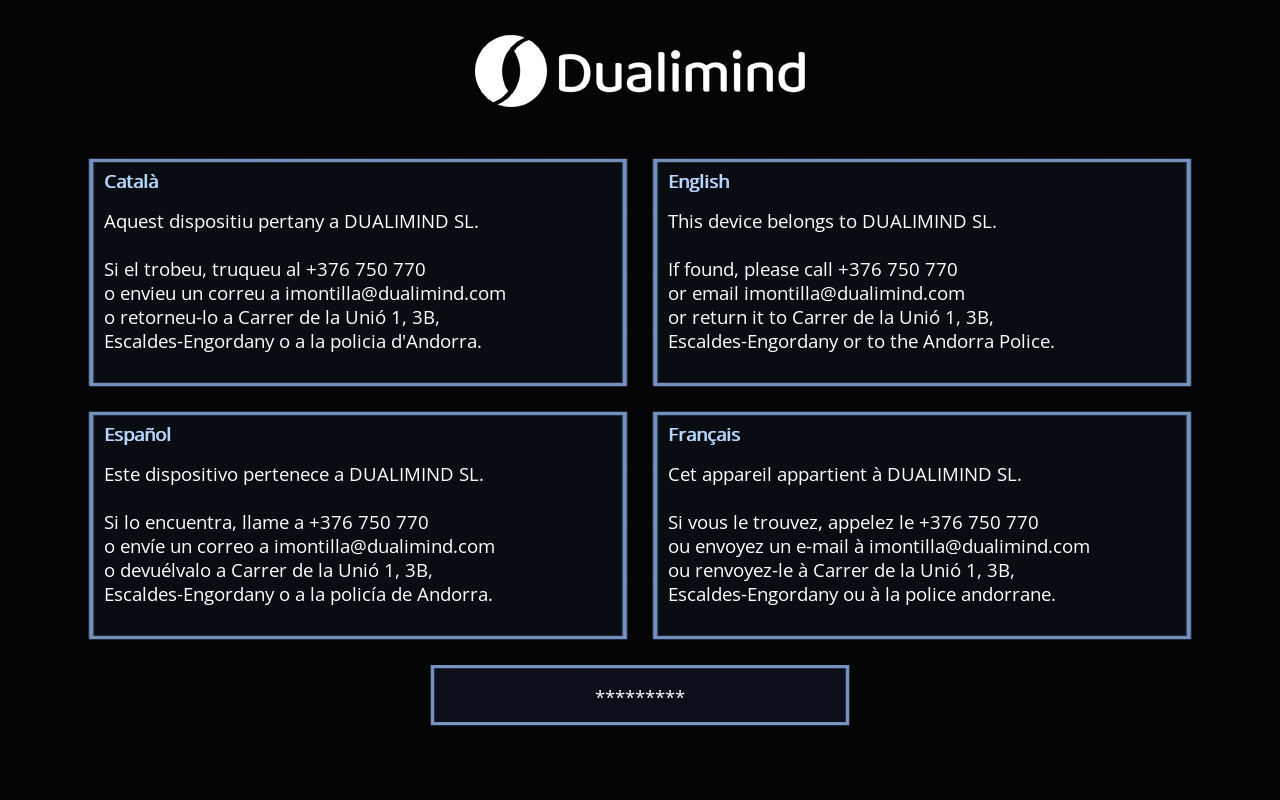
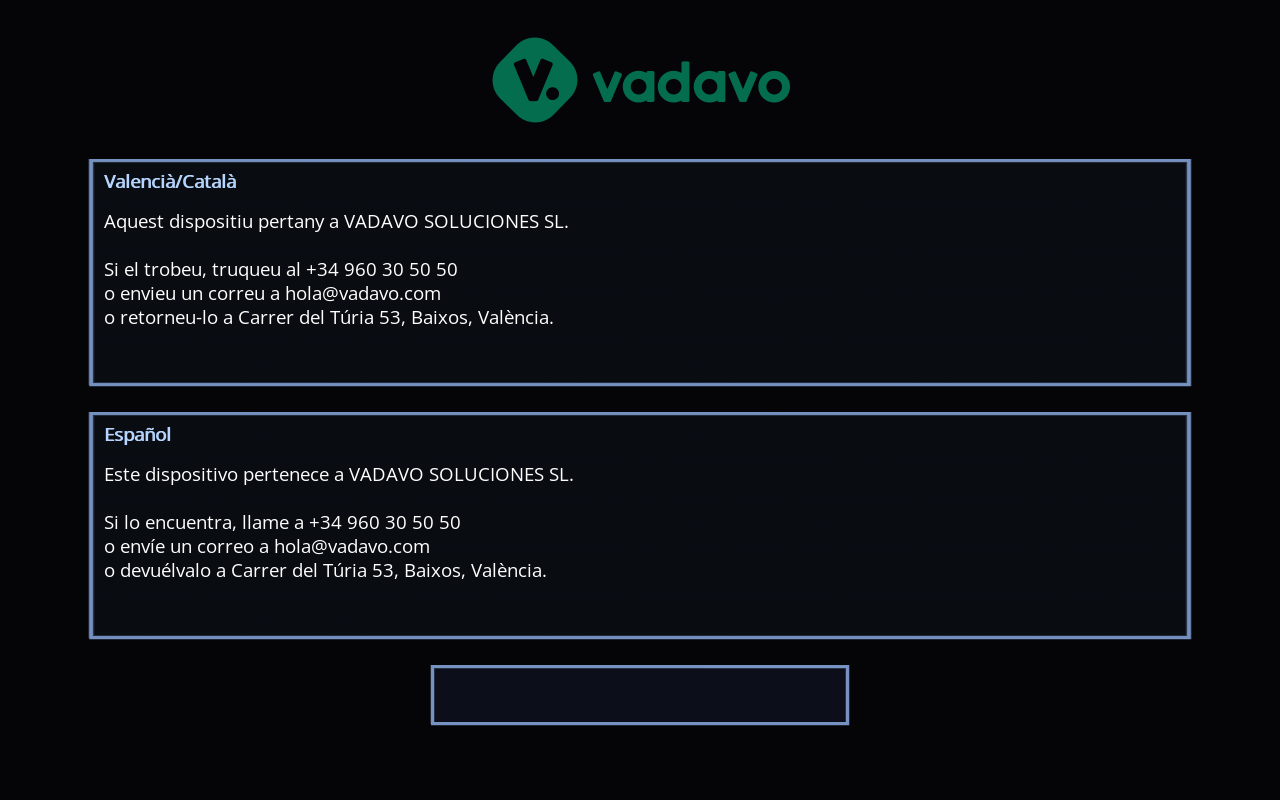
When enabled, the disk-unlock screen can show contact information before the operating system starts. The installer can render the message in selected language templates and optionally include a owner’s logo. This is public by design: if the machine is lost, a finder can see how to return it without needing access to the OS.
Those screenshots are examples from Dualimind and VADAVO, with the languages spoken in Andorra and Valencia (Spain).
Full Disk Layout
OpinionatedArch is designed to be installed on the whole target disk. Installing in a partition sharing disk with other OSes is not supported. If you install other OSes in other disks, you can add entries for booting in the bootloader without problem.
That all-disk model exists because OpinionatedArch has multiple partitions:
- a FAT32 boot partition for EFI boot files, the kernel and the Plymouth theme with the pre-boot ownership message.
- an EXT4 recovery-system partition
- an encrypted swap partition using an ephemeral boot-time key (maybe I’ll change it by a swapfile)
- an encrypted LUKS2 main-system partition containing Btrfs
Encryption is mandatory. There is no installer toggle to disable it. The boot partition remains unencrypted because UEFI needs to read boot artifacts before root unlock, and hibernation is not supported because swap uses an ephemeral key.
This is a trade-off-heavy project, and the trade-offs are documented rather than hidden. The full-disk model is strict, but it keeps installation, recovery, and rollback expectations easier to reason about.
⚠ Info
Btrfs Layout
Inside the encrypted main-system partition, OpinionatedArch uses Btrfs as the fixed filesystem model. The layout is not open-ended and does not try to support every partitioning preference.
The system uses:
@for system state@home-<login-user>for each login user’s home@logfor logs@pkgfor Pacman cache@snapshotsfor snapshot storage
⚠ Info
Update 2026-05-15: The BTRFS layout has been redesigned. The new layout is defined in the documentation.
Per-user home subvolumes are important because snapshots happen at subvolume boundaries. If every home lived inside one shared @home, restoring one context could accidentally roll back another. OpinionatedArch avoids that by giving every login user a separate rollback scope.
Automatic Checkpoints
The snapshot policy is designed around obvious human restore points. If something breaks during today’s work session, restoring to the snapshot taken before booting the system should be an intuitive recovery point.
System snapshots are created:
- at boot start
- on package installation or update transactions
- on explicit manual request
User snapshots are created:
- at login start for that specific user
- on explicit manual request
Automatic snapshots are kept with bounded retention. Manual snapshots are never auto-purged and must include a human-readable justification, because long-lived recovery points should be understandable later.
The snapshots cannot be booted from the bootloader, avoiding problems caused by forking the filesystem and making changes inside a snapshot. But there is an entry to load a recovery system with easy-to-use TUIs to find and restore snapshots.
Opinionated Means Fewer Branches
OpinionatedArch deliberately chooses a small set of defaults. Some fundamental components like the kernel, the audio system, the network stack or bootloader are pre-installed and pre-configured. You don’t need to do the typical Arch’s boring ritual of installing those fundamental components.
The point is not that these choices are universal. They are not. The point is saving time deciding about those fundamental components.
What OpinionatedArch Does Not Decide
OpinionatedArch does not impose a desktop environment, window manager, shell workflow, or general usage experience. The project is opinionated about the operating model, disk layout, encryption, recovery, snapshots, dotfiles, and maintenance invariants, but not about how the user should interact with the machine day to day.
A graphical desktop, a tiling Wayland setup, a TUI-heavy workflow, or a mostly terminal-based environment should all fit as long as they respect the system model.
Tools
The project includes a small operational tools with one purpose each.
Examples include:
oparch-user-createfor adding login users with the correct groups, home subvolume, and ownershipoparch-user-removefor removing users without leaving stale subvolumes or mount stateoparch-password-rotatefor keeping the shared LUKS and login secret synchronizedoparch-dotfiles-linkfor refreshing links from/dotfilesoparch-snapshot-system-createandoparch-snapshot-user-createfor manual checkpointsoparch-snapshot-restorefor explicit restore workflowsoparch-network-managerTUI for easily connecting to networks, both wired and wireless, from non-desktop recovery environment
These tools matter because the model has invariants. A login user is not just a Unix account. It also needs a home subvolume, snapshot paths, group membership, and consistent recovery behavior. Password change should apply for both LUKS2 encryption and for all login accounts. Dedicated tools keep those rules from becoming tribal knowledge.
Documentation as Part of the System
OpinionatedArch is not only scripts. The repository contains decision documents explaining the reason behind each major policy.
That is important because opinionated systems can otherwise become arbitrary systems. If a decision is strict, the project should say why it is strict. If a feature is deferred, the project should say why it is deferred. If a trade-off is accepted, the project should make that acceptance visible.
The documentation is part of the design, not decoration.
Comments
Loading comments...
Write a comment on GitHub!